
How to compare web design quotes fairly
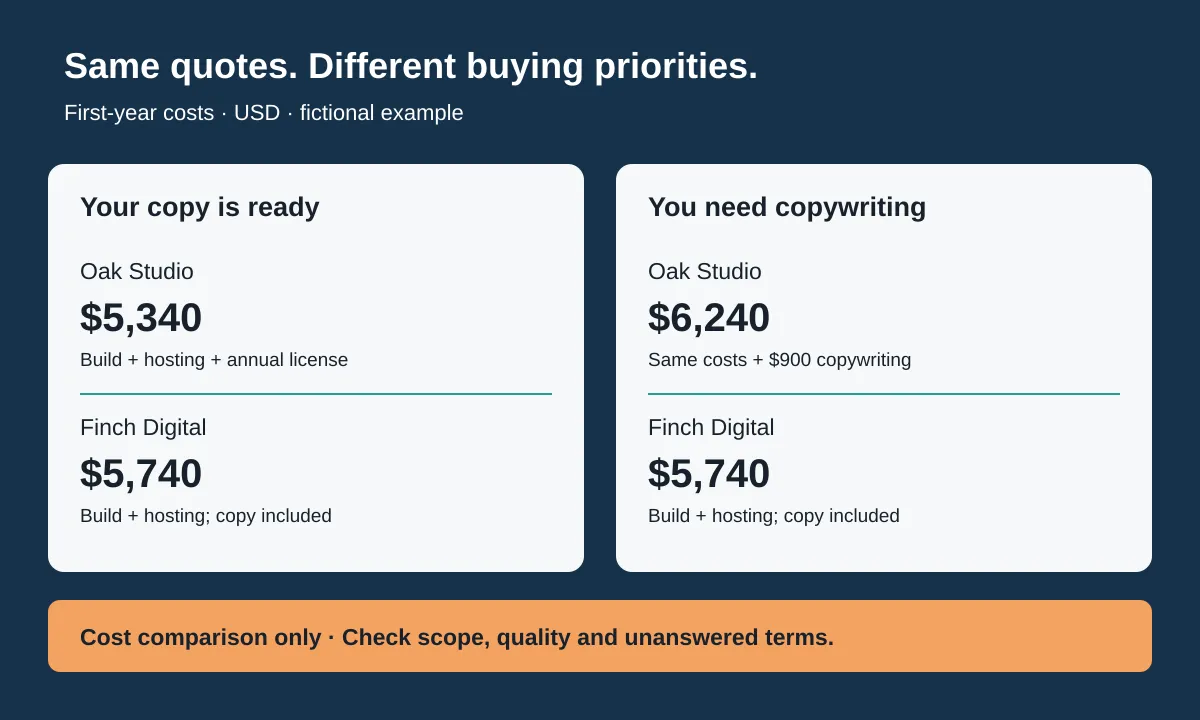
To compare web design quotes fairly, put each supplier against the same list of deliverables, then add the required costs over the same period. Keep optional charges and unanswered questions separate from that total. Choose against your priorities—such as copywriting, launch date and ease of editing—rather than assuming the lowest build price buys the same website.
How to compare web design quotes in five steps
- Write down the website you need: pages, features, content responsibilities and launch date.
- Copy each supplier’s stated scope into a side-by-side table, with proposal page or section references.
- Mark each item included, excluded, conditional or not stated.
- Calculate required costs over the same period, then show relevant extras separately.
- Ask suppliers to resolve gaps in writing before choosing.
Start with must-haves rather than a scoring system. A quote that omits your essential booking integration needs clarification or a revised scope before its price can be compared meaningfully.
Compare deliverables, not labels like “complete website”
A scope comparison is a table of the work each supplier promises to deliver. Use concrete outcomes: “five named pages with supplied copy entered” is more useful than “content support.” Copy this checklist into a spreadsheet and give each supplier a column.
| Compare this | What to record from each proposal |
|---|---|
| Pages and design | Named pages, unique layouts, template or bespoke design, revision rounds |
| Content | Who writes, edits, supplies images and enters content; any word or image limits |
| Features | Forms, booking, payments and integrations; third-party fees and setup responsibilities |
| Search and migration | Page titles, sitemap, old-to-new URL mapping and redirects, if relevant |
| Testing | Named browser/device checks, performance targets and accessibility testing scope |
| Handover | CMS access, training, files, domain and hosting account control |
| After launch | Bug-fix period, maintenance tasks, response times and limits on edits |
| Commercial terms | Fixed price or estimate, tax basis, payment stages, renewal and cancellation terms |
“Not stated” means the document doesn't answer the question. It doesn't establish that work is included, excluded or free. Keep it distinct from an explicit exclusion so you can ask the right follow-up.
For a redesign, redirects deserve their own row. Google’s site-move guidance describes mapping old URLs to new destinations and setting up redirects. Ask who produces that map and tests it; “SEO included” doesn't tell you.
Separate required costs, conditional charges and unknowns
A required cost is a fee you must pay under the quoted arrangement. A conditional charge applies if a stated event happens, such as requesting another design round. An unknown is a missing price or term that prevents a complete calculation.
Use a common period—such as the build plus the first 12 months after launch—and the same currency and tax basis. Count a required support commitment even if you don't expect to use much support. If a commitment runs longer than your comparison period, show the remaining obligation separately.
Your working total is:
Build fee + required recurring fees during the period + required one-time extras.
Then add separate lines for likely optional work, change scenarios and unpriced items. Don't turn an hourly estimate into a fixed total: record the estimated hours, rate, cap if any, and who approves overruns.
Worked example: a cheaper build can cost more with copy
This fictional example uses two five-page website proposals for a small consultancy. All figures are USD, on the same tax-exclusive basis, with recurring costs covering the first 12 months after launch. The buyer needs a contact form and the ability to edit text.
These are the source excerpts for the comparison:
- Oak Studio proposal, p. 1, “Deliverables”: “Five-page website, contact form and editable CMS. Client supplies page copy. Two design revision rounds included.”
- Oak Studio proposal, p. 2, “Fees”: “Fixed build fee $4,800. Required hosting $25/month and annual plugin license $240. Optional copywriting for all five pages $900. Additional design rounds $250 each.”
- Finch Digital proposal, p. 1, “Deliverables”: “Five-page website, contact form and editable CMS. Copywriting for all five pages and two design revision rounds included.”
- Finch Digital proposal, p. 2, “Fees”: “Fixed build fee $5,500. Required hosting $20/month. No separate plugin license charge. Additional design rounds quoted on request.”
| Cost or scope item | Oak Studio | Finch Digital |
|---|---|---|
| Fixed build fee | $4,800 | $5,500 |
| Required first-year hosting | $300: $25 × 12 | $240: $20 × 12 |
| Annual plugin license | $240 | No separate charge stated explicitly |
| Required first-year total | $5,340 | $5,740 |
| Five-page copywriting | Optional $900 | Included |
| Total if copywriting is needed | $6,240 | $5,740 |
| One extra design round | $250 | Price unknown |
The cost entries come from each proposal’s p. 2, “Fees”; the content and revision allowances come from p. 1, “Deliverables.”
If the consultancy has approved copy ready to supply, Oak has the lower stated first-year cost by $400. If the consultancy needs the quoted copywriting service, Finch has the lower comparable cost by $500. Neither calculation establishes better design quality or a guaranteed saving.
One extra revision would take Oak’s copywriting-needed scenario to $6,490. Finch’s equivalent scenario can't be totalled until Finch supplies the extra-round price. Leave that cell unknown rather than adding zero.
Both proposals still need answers about launch timing, post-launch fixes and account handover. A favorable cost calculation doesn't resolve those gaps.
Judge value against your priorities
Choose a priority before declaring a preferred quote. If your team has no writer, included copywriting reduces a measurable scope gap. If your team already has approved content, that inclusion may matter less than the editing workflow or deadline.
Check quality separately from scope. Ask to see a live site with similar features and have the supplier demonstrate how you would make a routine update. Confirm whether the people responsible for those examples will work on your project.
Treat ambiguous commercial terms as questions to clarify. Ask what triggers final payment, how changes are approved, what happens if the launch is delayed, and what you receive when the relationship ends. Take consequential contractual concerns to a qualified adviser before signing.
Send every supplier the same clarification request
Use this email after filling the comparison table:
Thanks for the proposal. Before we decide, please confirm the following in writing and identify any change to the quoted price:
- Which named pages, features and content tasks are included? Who supplies and enters the copy and images?
- What must we pay for the build and the first 12 months after launch, including hosting, licenses and required support? What is the tax basis?
- What counts as a revision round, what does an extra round cost, and how are other changes approved?
- What launch date can you commit to, and which inputs or approvals must we provide by which dates?
- Which accounts, files and access rights do we receive at handover? What work and charges apply if we move to another supplier?
- What fixes or maintenance are included after launch, for how long, and what renews automatically?
Please send an updated proposal or scope schedule reflecting these answers so we can compare the same requirements.
See a source-linked comparison
DemonRate’s free fictional proposal comparison shows fees, scope, commercial terms and supplier questions with inspectable source passages. Change the buyer’s priority to see how the trade-off changes before applying the method to your own quotes.